
Just outside the tourist fishing village of Mahdia lies Residence Paradise, a holiday apartment that was never finished.
DESTINATION PARADISE
While European tourists enjoy a fairytale holiday on the Tunisian beaches, police violently hunt down migrants at sea and along the coast to deport them. The human suffering caused by police actions is the price migrants pay for the EU's Tunisia deal.
Meanwhile, the same number of boat refugees are still arriving in Italy. The destination hasn't changed, but the country of departure has.

A migrant takes a photo of the sea and the marina at a viewpoint in the popular village of Sidi Bou Said near Tunis.

A group of tourists dancing at a resort on the beach near Port El-Kantaoui. The soapy water comes from a cannon operated by resort staff.
There can be many reasons why people want to escape their daily reality and begin to long for a place they'd rather be. The travel industry capitalizes on this unconscious tendency toward escapism by promising immersive, authentic experiences in far-flung destinations and by promoting resorts with catchy names that evoke a royal, exotic, and certainly carefree atmosphere.
While European tourists indulge in a luxurious beach holiday in Tunisia, migrants risk their lives a little further afield to reach the dream Europe. These contrasting worlds, like polar opposites, revolve around each other along the coastline. To entertain themselves, tourists cruise along the coast in a mock pirate ship that could easily appear on the cover of a Lego set. Or they don a life jacket and, together with friends and family, let themselves be pulled across the Mediterranean Sea on an inflatable banana by a speedboat. The resemblance to the now-familiar image of African migrants in rubber boats, with both legs on either side of the air-filled cylinders for balance, is obvious. At the same time, the contrast between the two types of travelers couldn't be greater.


Tourists take a selfie at the Safari Shopping Center, located near fancy resorts in a tourist enclave near Monastir.
The average tourist stays mainly in their secure all-inclusive cocoon, and at most sees a few women begging on the street. If any of "dark" Africa does appear in their view, it's as a tourist attraction and in a childishly naive representation. For example, near Sousse, there's a zoo designed as a large African village where flown-in South African Zulus play music and dance for and with the visitors. Another example is the Safari Shopping Center located in a tourist enclave near Monastir. It depicts a primitive Africa of rugged warriors, wild animals, and dancing women. It's as if the architect was inspired by dated comics full of clichés about the colonial era on the African continent. But beyond the tourist enclaves and attractions, little of the fairytale land remains.

The beach at Port El-Kantaoui.

A food stall specializing in camel meat on the coastal road
from Sousse to Monastir.

Street scene from the boulevard of the tourist fishing village of Mahdia.

A square in El Djem near the largest Roman amphitheater
on the African continent.

A Sierra Leonean woman begs with her two children opposite the mosque in the medina of Sousse.
A Migrant Safari
What does the world of migrants in Tunisia look like? And what do they experience daily? Instead of a better life in Europe, they've become stranded on the Tunisian coast, without food, water, money, humanitarian aid, medical care, or a place to stay. The National Guard hunts migrants in cities and in their self-built camps—also a kind of enclave, but illegal—between El Amra and the port city of Sfax, robbing them and deporting them. Every week, bulldozers destroy their shelters somewhere under the olive trees, made of discarded furniture and plastic.
A National Guard convoy of eight police buses, two coaches and three bulldozers stands ready at El Amra to destroy a migrant camp.
All those arrested face the same fate: first, the police confiscate all their possessions (money, phone, documents). Then, silently, handcuffed, and hunched over, they are forced to take their seats in waiting tour buses. Their destination is the border with Algeria or Libya, where they are chased into the desert with beatings. According to a September 2024 publication in The Guardian, women are systematically raped by National Guard officers. If the police haven't already sold the detainees to a militia group waiting at the border, the migrants begin a weeks-long return journey to their previous homes on the Tunisian coast, without food or water. Many die, and the survivors see no other way out than to start over and save up for another attempt to cross the Mediterranean. It has cost them and their families too much to get this far, and failure is not an option.

In the olive groves along the road from Sfax to El Amra, there are several (illegal) camps housing migrants. This one is located at kilometer marker 24.

When the farmer comes by on a tractor to water his olive trees, the migrants can have their bottles refilled. Some migrants demonstrated drinking the chemically contaminated water and showed the bumps they got on their skin. An alternative is drinking seawater.
No reports allowed on migrants
For some time now, film crews have not been allowed to report on migrants. And recently, media authorizations have been withheld altogether. In this way, the government attempts to conceal the violent methods used to stop boats bound for Europe and to dump arrested migrants in the desert.
Despite the ban, journalists from Arte managed to secretly film the repression. Their July 2025 report reveals that the government's approach completely falls short of the respectful, humane treatment agreed upon in the 2023 migration deal with Europe. For example, videos filmed by migrants show a "rescue operation" at sea. The coastguard grazes overcrowded, sometimes homemade, boats, attempting to capsize them. If that fails, they attempt to run over one of them. Officers beat the paralyzed occupants with sticks. A mother can be heard screaming for her baby. In a subsequent clip, migrants are seen drifting in the sea.

The driver of a tourist carriage hails a taxi for his customers near the medina of Sousse. A very emaciated migrant crosses the street.
Aid workers arrested
It is illegal in Tunisia to provide assistance to migrants in any form whatsoever. Giving a bottle of water is sufficient grounds for arrest. After dozens of national and international aid workers were arrested and accused of participating in a criminal organization, their organizations were forced to close. How do migrants survive in a country where apartheid has been reinvented and work is officially forbidden?
In some neighborhoods of the capital, Tunis, and other major cities, illegal labor seems to be tolerated. Even there, police can arrest someone at any time. Men work on construction sites, tinker with cars in garages, or perform odd jobs for entrepreneurs or private individuals. Women sometimes find work in cafés or restaurants or as domestic helpers for a "madam." Mothers with young children beg at mosques or on the sidewalks of shopping streets, while others offer sexual services on more remote access roads.


Camps are systematically destroyed
"Life in Tunisia is exceptionally hard," says 26-year-old Anita from Sierra Leone, who experienced several police raids. She spent a year in a camp near El Amra until she became pregnant and left for Sousse. “During a massive raid with bulldozers, about fifty officers use pepper spray and electric shocks to keep us from running away. They take children from their mothers and place them in orphanages. Every time the police tore down and burned our tents, we rebuilt everything. Because we have nowhere else to go.”
According to Anita, there's a strong sense of community in the camps. Anyone who has something shares it with others. Cooperation is essential for survival as a group. At the same time, people regularly die from disease and lack of medical care. Then someone calls an ambulance to come and collect the body.
To earn money, Anita begs on the streets. "Every day you encounter good and bad. I often get something slipped to me by a woman who visits the supermarket here. Older men only give money in exchange for sex. But I don't do that. What hurts me most is the daily discrimination. I've been refused boarding buses more than once. Even when people give us something, they try not to touch us, as if we have a disease."

They say two words: money, phone.
After a long journey from his native Gambia, 25-year-old Lamin arrived in Libya and made two attempts to reach Europe. “Both times I was arrested and imprisoned in a Libyan prison. That was the worst thing I ever experienced. When I managed to escape after a year, people said: go to Tunisia. I tried twice here too. We left with about forty people, and only a few came back. We didn't capsize because of the waves, but because we were attacked by the coast guard. Many of my friends drowned.”
Lamin is staying in a camp in Sidi Abid, a poor neighborhood in the port city of Sfax, wedged between the back of the international airport and a large industrial complex by the sea. “The police are making it impossible for us to live here,” says Lamin. “I sleep poorly for fear of a raid. Last month, the police entered our camp, shouting. They say two words: money, phone. Then they ask where you're from. They don't write down your name. After that, we're deported by bus to the desert. They say: there's Algeria, go there. They beat us if we don't keep going. It took us nine days to walk back. But you can also be arrested on the street. Sometimes the police take your phone and money and throw you off the bus after ten kilometers. Sometimes you're taken to Algeria and sold there.”
Lamin has been away from home for nine years now and is close to despair. “We have no place to live here. Finding drinking water, washing, cooking—everything is a problem. People aren't allowed to give us work. Yet I try every day. If you see the police, you have to run. Usually I find nothing, sometimes I'm lucky. In winter, we go door-to-door begging for blankets. When we're sick, we can't go to a hospital. We drink tea made from boiled berries; it eases the pain a bit like paracetamol. When I go to a café to watch football, I'm turned away. They say: forbidden. That's because I'm Black. They don't want us here. I don't understand why life is so difficult for me. Sometimes I'd rather be dead.”

Lamin from Gambia (left in the photo) lives with other migrants in a camp near Sfax.
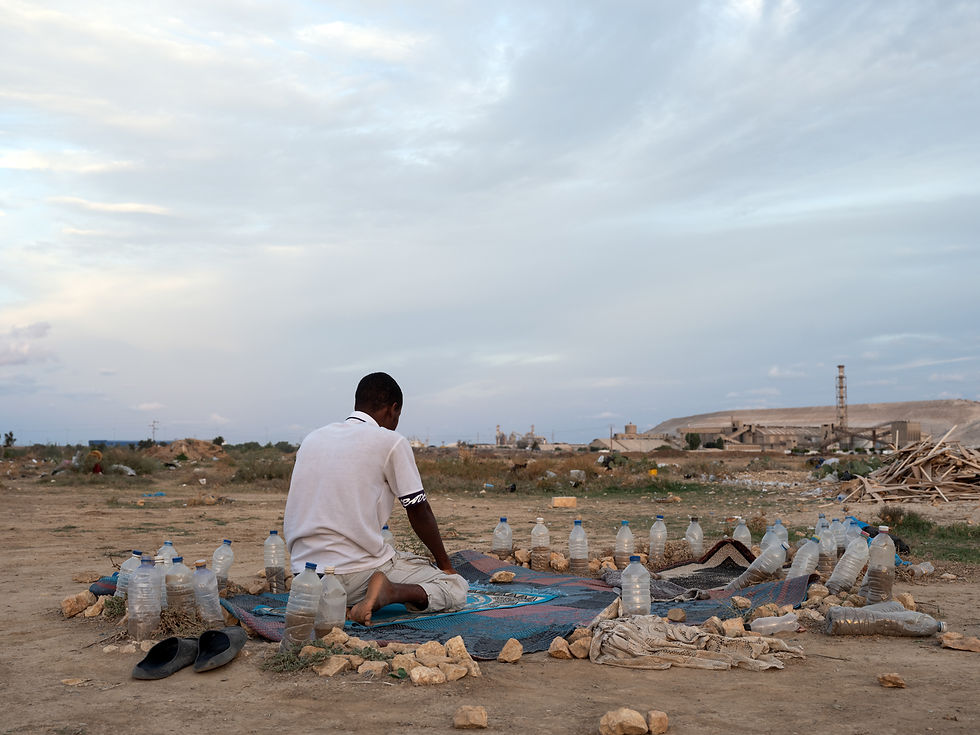


Hidden among the rubble and concealed under bushes, several hundred migrants have built shelter from rubbish gleaned from the streets of Sidi Abid, a poverty-stricken neighborhood of the port city of Sfax, located between the airport and an industrial estate.
More migrants want to return home
The effect of the repression has been an increase in the number of migrants registering for the European-funded return program, which is implemented by the International Organization for Migration (IOM), part of the UNHCR. In 2024, 17,366 migrants were registered and 6,855 were repatriated. In the first half of 2025, 5,336 migrants returned to their countries of origin. Because there is insufficient space in shelters for all those on the return list, waiting times of six months or longer have arisen. Those on that list have to fend for themselves for the entire period.
One of the migrants who wants to return is 20-year-old Abdoul from Ivory Coast. He was standing at a café on the beach in Mahdia, very relaxed, serving customers in French and Arabic. "I'm the only Black person on the beach," says Abdoul. "The first time, people looked at me strangely, and I just wanted to get away as quickly as possible." Without access to textbooks and without teachers, Abdoul learned to make himself understood in Arabic in Libya. Now, he's so fluent in the language that tourists regularly ask if he's Tunisian. His multilingualism made him an attractive employee for the owner of the beach café. "My lack of papers wasn't a problem; he would talk to the police."
During the peak tourist season (April–October), Abdoul spends his days on the beach day and night. "My boss trusts me completely," says Abdoul. "I do all the work and call him if there's a problem. I keep a ledger with the earnings. I've never kept anything for myself. But when I ask for my wages, I don't always get them. I had hidden my savings, and one day it was gone, stolen by a Tunisian boy I'd been watching for a while."
Because there's no work for him during the winter months, Abdoul left for a camp near El Amra at the end of last year. There, he attempted to reach Europe in a metal boat. "We were quickly stopped by the coast guard," Abdoul says. "Give us the engine, give us the engine, the officers shouted. They left us at sea without an engine. That same night, fishermen found us and took us in tow."
After two failed attempts to reach Europe, Abdoul now wants to return to his native country to start a restaurant. "When I told my boss, he just said, 'Good luck.' Nothing else. No thank you, no extras at the farewell. In fact, he still owes me money. To him, I'm a reliable, cheap laborer. But to me, it feels more like I'm his slave."


An impression of Abdoul's work, eating and sleeping area on the beach of Mahdia.
Net Number of Boat Refugees
Tunisia, like Morocco and Mauritania, receives hundreds of millions of euros from the EU to stop migration to Europe. An in-depth investigation by Lighthouse Reports in these North African countries revealed that the EU has been aware of the systematic desert dumping for years and that European-supplied equipment is being used in human rights violations. An EU consultant involved told the researchers that the aim of these deals is to make life so difficult for migrants that they eventually return home voluntarily. And that it deters new migrants from coming.
European politicians claim that the Tunisia deal is working, because significantly fewer boats from Tunisia are reaching the Italian island of Lampedusa. Yet, that's not the whole story. According to the latest UNHCR figures for 2025, 55,976 people arrived on the Italian coast by October, 2% more than in 2024. The vast majority (49,792) departed from Libya, and the remainder (3,947) came from Tunisia. A recent article in the Dutch newspaper Trouw already showed that the number of migrants leaving Libya for Italy had increased by 66%. It's not the destination that has changed, but the country of departure. A textbook example of the waterbed effect: apply pressure in one place and the water rises elsewhere.
The EU plans to sign agreements with more countries to keep migrants and refugees away, despite alarming and well-documented investigations by human rights and aid organizations. Amnesty International's latest report (published on November 6, 2025), "Nobody Hears You When You Scream", shows that the routine attacks on Black migrants, deportations, robberies, assaults, and rapes are a direct result of structural racist rhetoric, fueled by statements made by President Said in February 2023. Amnesty calls the EU's silence on the human rights violations alarming. According to the organization, by failing to critically monitor cooperation with Tunisia, European politicians risk becoming complicit.
By continuing to ignore human rights violations, these politicians can continue to believe in the fairy tale that they are doing something good to stop migration to Europe. That, too, is a form of escapism. And—seen from the political perspective of attracting votes in the next election—also a profit model. Just like the agents who profit from the migrants they have to chase out of the country and the entrepreneurs who make them work hard for a tip.

An internet cafe in Hamman Sousse.

A saleswoman prepares her mobile shop on the boulevard of Sousse.
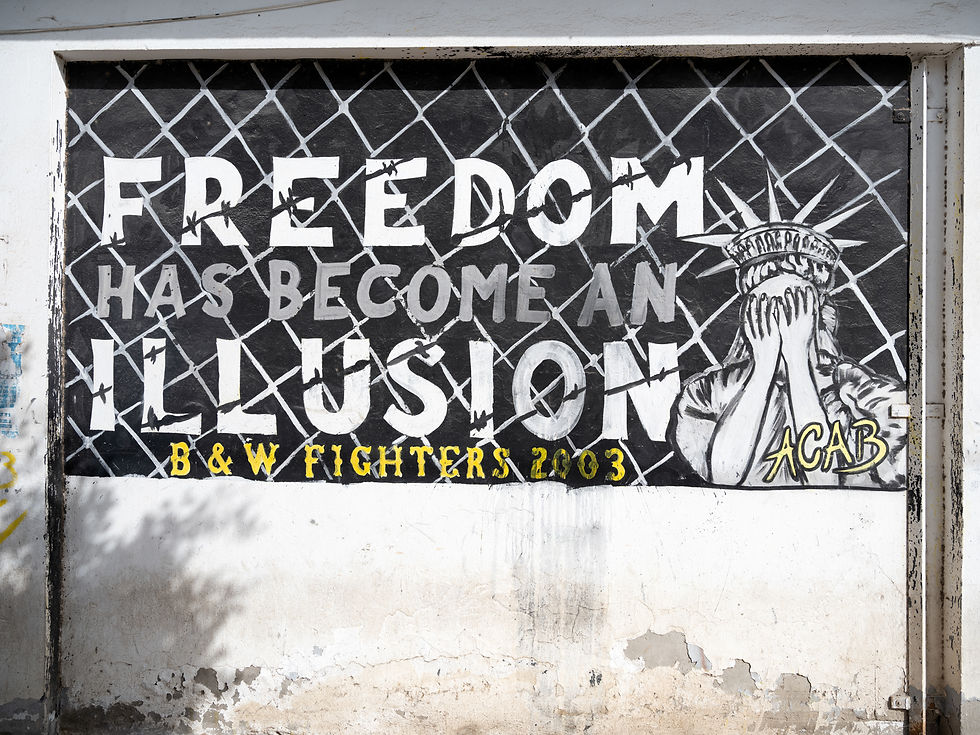
A mural of football supporters in the port city of Sfax. The black and white design refers to the club's uniform, and the year is the club's founding year.

The view from Residence Paradise. The tourist apartment complex near Mahdia was never used.