
Police checks are a daily occurrence. If the paperwork is incorrect, migrants can be ordered by the court to leave the country. Many then disappear into illegal residence.
Off the radar
Migrants in Genoa are disappearing from the radar due to the harsh approach to immigration, making them vulnerable to exploitation. "Everyone wants to participate in society, but they're not given the opportunity to work. As a result, more and more migrants are disappearing into the black hole of illegality."

The port of Genoa.

A migrant cleans the hull of a ship in the harbor. Many migrants do work for which no Italians can be found.
They thought they had left Gambia with a ticket to a better life in Europe. When, in the desert, they realize they've been sold as merchandise to Arabs, there's no way back. Lamin Fadera and Madou Camara, then fourteen years old, are sitting with more than thirty others in an open pickup truck, with no room to stretch their legs. The sun beats down mercilessly on their skin. The first passengers have already died of dehydration. Jumping out of the pickup truck is tantamount to committing suicide. Their lives are worth no more than what the next buyer will pay for them.
During the three-day journey through the desert from Niger to Libya, the two are equally unaware of the hell that awaits them. No one in Gambia had told Lamin and Madou that they would be arrested upon arrival in Tripoli. That they would spend six months in an overcrowded prison cell, surviving on bread and water. That they would watch fellow prisoners die before their eyes. That the guards would fire their guns at random into the escape group during their nighttime escape. That, to survive in Tripoli, they would board a van without knowing where the journey would take them, what kind of work they would be expected to do, or whether they would even be paid for it. That they would be locked up, beaten, and threatened with death. That only after four months would they have enough money to pay for the crossing to Europe. That they would board a rickety boat to be rescued by a Spanish ship. That after arriving in Sicily, they would be locked up in a camp for minors for eleven months. And that, out of sheer frustration at the long wait and inaction, they would flee this camp to travel to Genoa.


Lamin Fadera (left) and Madou Camara from Gambia endured a "journey through hell" before receiving shelter and support from an aid organization in Genoa. They live with three other boys in an apartment run by Il Cesto, one of five aid organizations in Genoa's city center. Because their budgets have been nearly halved, the quality of housing for migrants in the shelter will drastically decline.

A police check in the historic center of Genoa.
Arrival in Genoa
By the time Lamin and Madou reach the ancient port city on the Mediterranean Sea, the political landscape in Italy has changed. The country is in an economic crisis, struggling with a massive debt burden and an aging population. There are concerns about the large number of young people leaving for abroad because they can't find work in their own country that matches their qualifications. At the same time, international aid organizations rescue hundreds of Africans every week in the Mediterranean Sea and deliver them to the port of Lampedusa. And many ordinary Italians are growing resentful of the newcomers who are flooding their country and are unable to travel on to other European countries.
It proved to be the ideal mix for a political revolution. In June 2018, the first fully populist government in Western Europe came to power, with Matteo Salvini as Minister of the Interior. The Lega leader promised to do everything differently: lower the retirement age and taxes, create more jobs, and end the influx of migrants. To make Italy safe again, Salvini believed it was necessary to deport illegal immigrants en masse.

Many migrants hang around in the historic center.


A man is suspected of theft and taken away by a shopkeeper.


Kitchen of the aid organization Casa Della Giovane. On Tuesdays, Wednesdays, and Thursdays, around 400 poor elderly people, drug addicts, the homeless, and migrants come here for a free hot meal. This international Catholic organization has numerous branches and services and is funded by the Vatican in Rome.
Participating in society has become more difficult
In Genoa, the organization Il Cesto is caring for newcomers Lamin and Madou. They each receive their own room in a tidy apartment and some pocket money, learn Italian, and take technical training to become mechanics.
Despite this, their regular counselor, Valentina Perelli, is pessimistic about their prospects. Lamin and Madou's asylum application has been rejected by the state because, according to European guidelines, they are not genuine refugees. Their appeal is not expected for about three years. Until then, Lamin and Madou are allowed to work, but they cannot register with the municipality. Without an identity card, they are also unable to participate in national projects to gain work experience. For migrants, this is a necessary stepping stone to a permanent job. In the Italian labor market, one's own network—not personal skills—is still the decisive factor in finding work.
When asked what future Lamin and Madou envision for themselves, there's a long silence. Then, with tears in his eyes, Madou says: "My only dream is to be able to provide for my own family. That's why I left Gambia. It's true that things are a bit better now that we're here and going to school. But I can't really think about a future. My head is still full of everything we've been through. If I had known this, I would have jumped out of the pickup truck in the desert."

Streetart in Genua.
Exploitation of migrants without residence permits
The prospects aren't only bleak for these two young Gambians. Only those with a permanent job are still eligible for a permanent residence permit. The rest are ordered to return to their country of origin on their own. Because this doesn't happen, more and more migrants are disappearing from the radar. It is estimated that there were half a million "clandistini" in Italy in 2019. Without money, shelter, or language skills, they become entangled in the networks of criminal organizations. Many of them turn to drugs or become dealers themselves. Young women, primarily from Nigeria, are forced to work as prostitutes to pay off their debts, which range from 20,000 to 50,000 euros. The women offer themselves along Italian provincial roads and in major cities for amounts starting at €20. Others are used as modern-day slaves in factories, in agriculture, in tomato picking in Campania and Apulia, on tobacco plantations, and in construction.

A young Senegalese man in Via di Pré. In Genoa, the population primarily associates Senegalese with the drug trade. Nigerians are said to dominate the trafficking of women.


Prostitutes offer themselves for €20 in the narrow alleys of the ancient city center. Many women have come to Italy through criminal organizations and owe between €20,000 and €50,000.
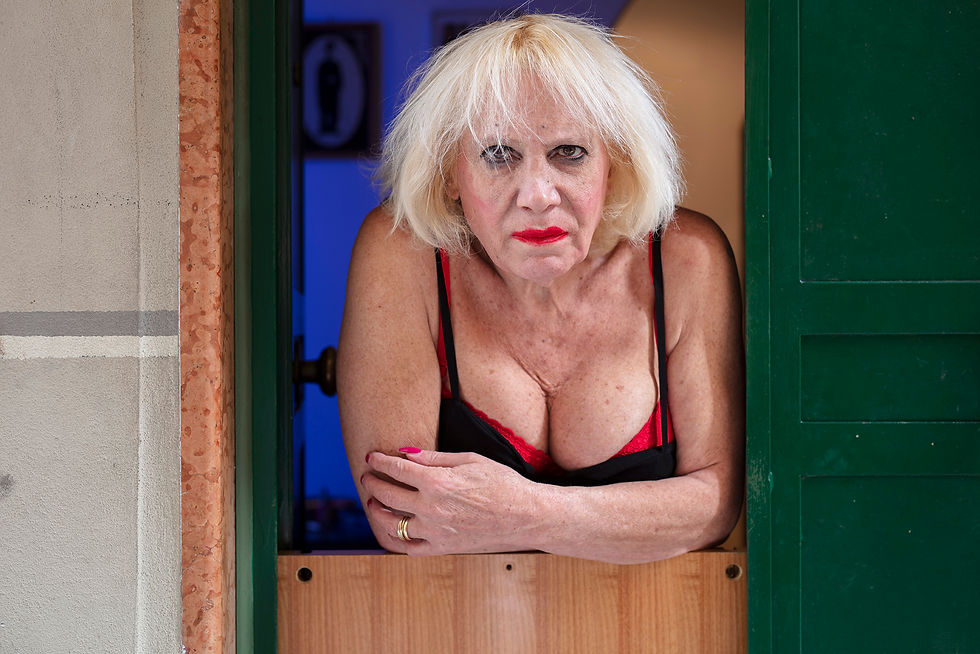
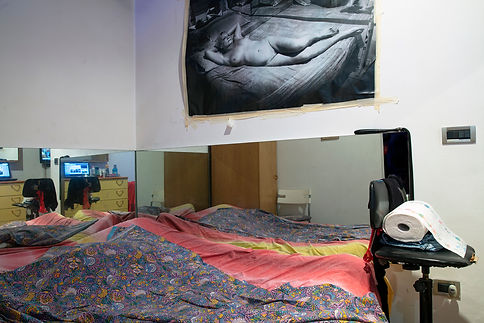
Italian Ulla Rosi has been working as a prostitute in Genoa since 1970. She started at fourteen and is 63 years old in the photo. The photo above her bed was taken in the same room by a photographer from Rome.

The Church Helps… and Profits from the Migrants
Nicolo Anselmi, auxiliary bishop of Santa Maria delle Vigne in the heart of Genoa, also notices that the problems with drugs and prostitution are worsening. As he walks out of the centuries-old basilica towards Piazza del Santo Sepolcro, he finds himself in the heart of the district where drug dealers and prostitutes station themselves in dark alleys for passing clients.
Anselmi estimates that there are about a thousand people in Genoa who have been undocumented for more than three years but are not being deported. "The problems arise when we are forced to let people go after about two years. Everyone wants to participate in society, but they are not given the opportunity to work. There is a lack of structure and policy for these people. As a result, more and more migrants disappear into the black hole of illegality."

A woman from Sri Lanka in the Chiesa di San Giovanni di Pré.
It is striking that the Catholic churches, based on their tradition of charity, are also active as aid organizations. For example, the auxiliary bishop has rented nine apartments to accommodate and support about fifty migrants. He estimates that all the churches in Genoa together provide "bed and bread" for some 500 to 600 migrants. This charity is certainly not entirely selfless. Like other aid organizations, the church receives compensation from the state. This was initially €34 per person per day, but was reduced to €18 with the implementation of the "Decroto Salvini."
Valentina Perelli of Il Cesto is particularly bothered by the new rules for using this compensation. For example, it can no longer be used to pay the registration fee for language classes. Besides forcing migrants to contribute more themselves, they also have less pocket money. At the same time, the reduction forces aid organizations to cut back on housing costs and staff. Perelli: "The quality of housing for migrants will deteriorate, and support will increasingly be provided by volunteers. I expect that many aid organizations will feel compelled to close their doors. Because people with complex needs are left to fend for themselves, it will become even more difficult for them to integrate."

There is a shelter for the homeless in Genoa, but the demand for a bed and shower exceeds the available capacity. Italians can stay there for a maximum of six months, while foreigners have to make room after just one month. Those who can't find shelter anywhere else sleep outside.